
Hindoos— St. Helena— History of the changes in the Vegetation— Cause of the extinction of Land-shells— Ascension— Variation in the imported Rats— Volcanic Bombs— Beds of Infusoria
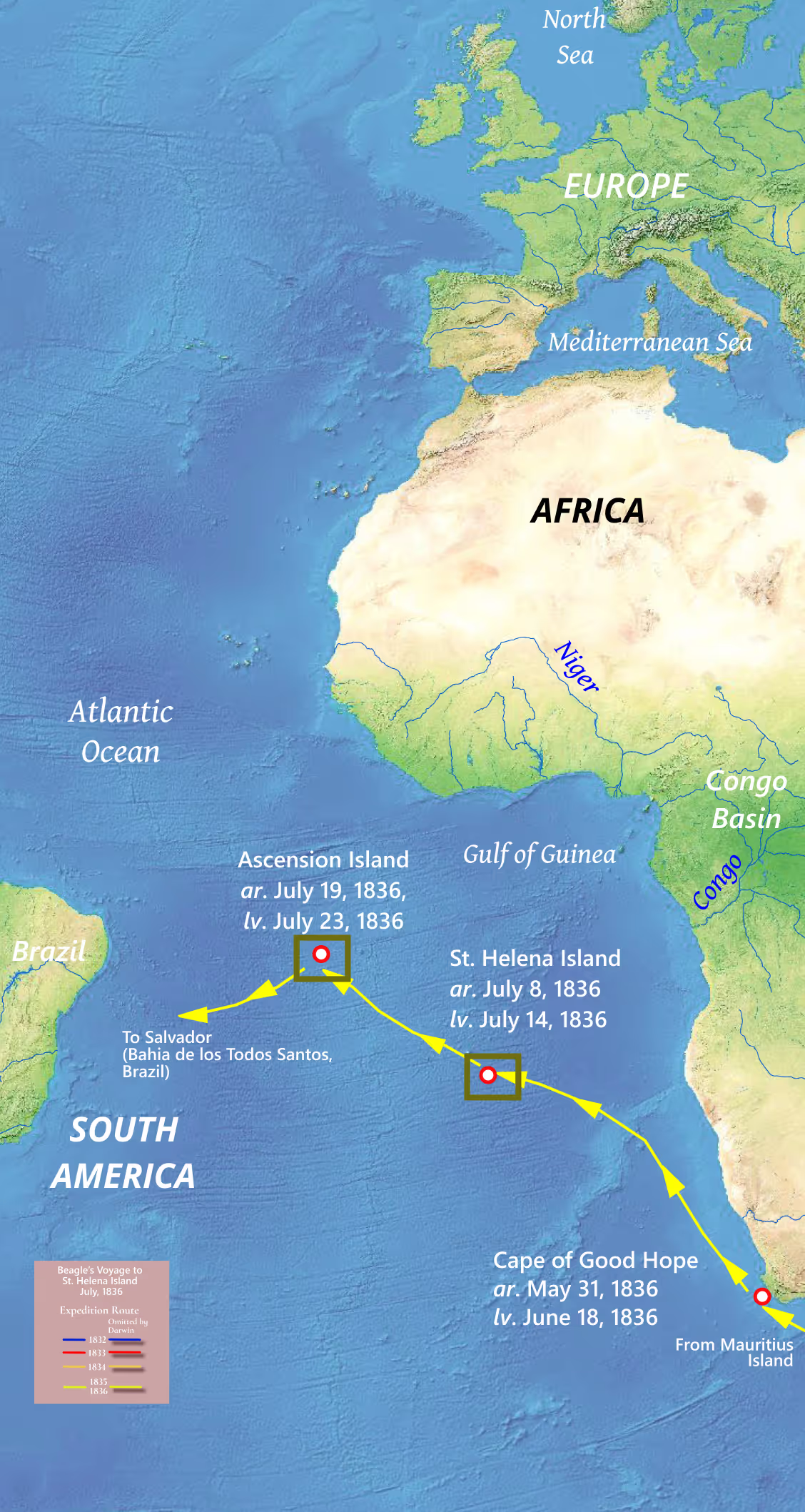
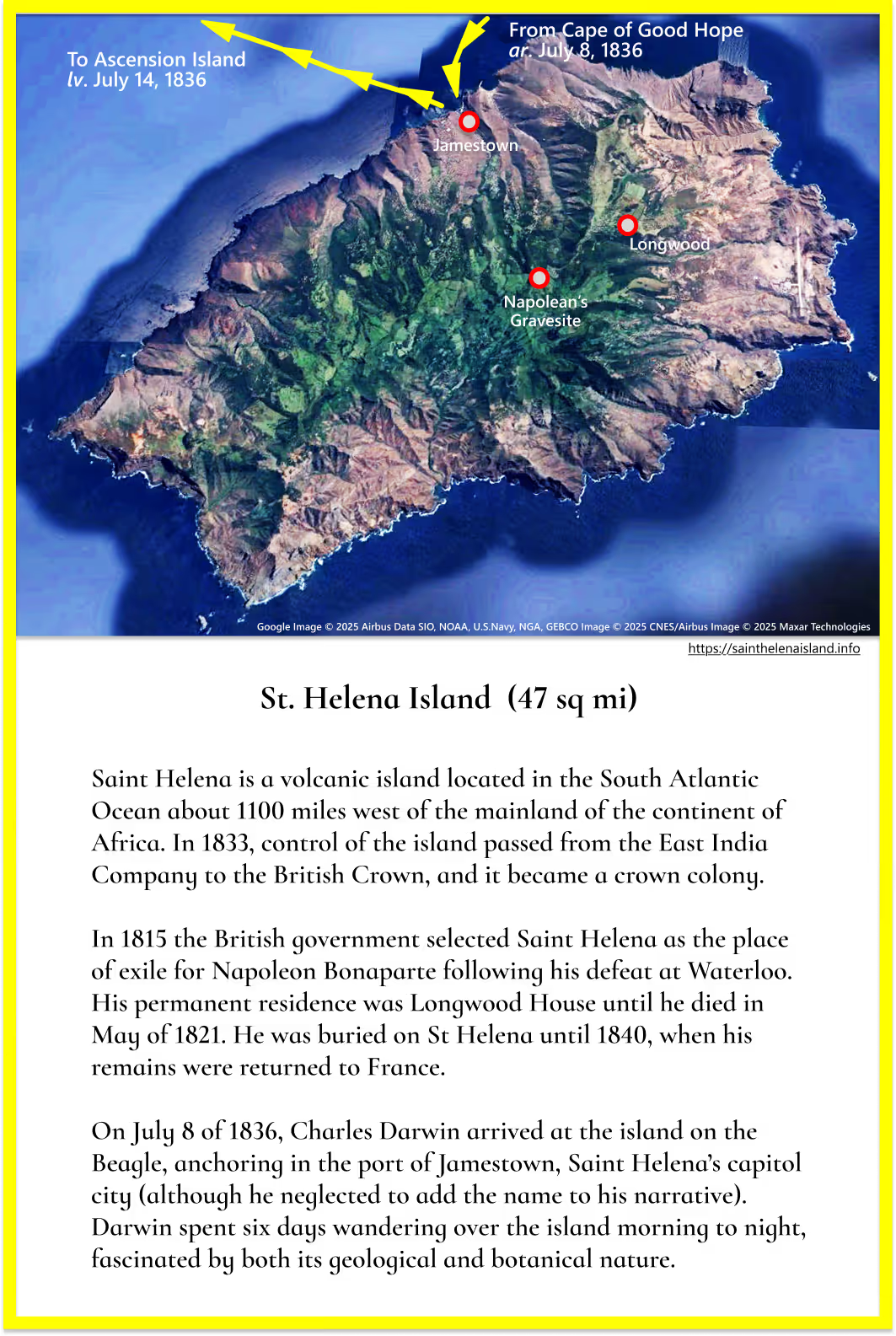
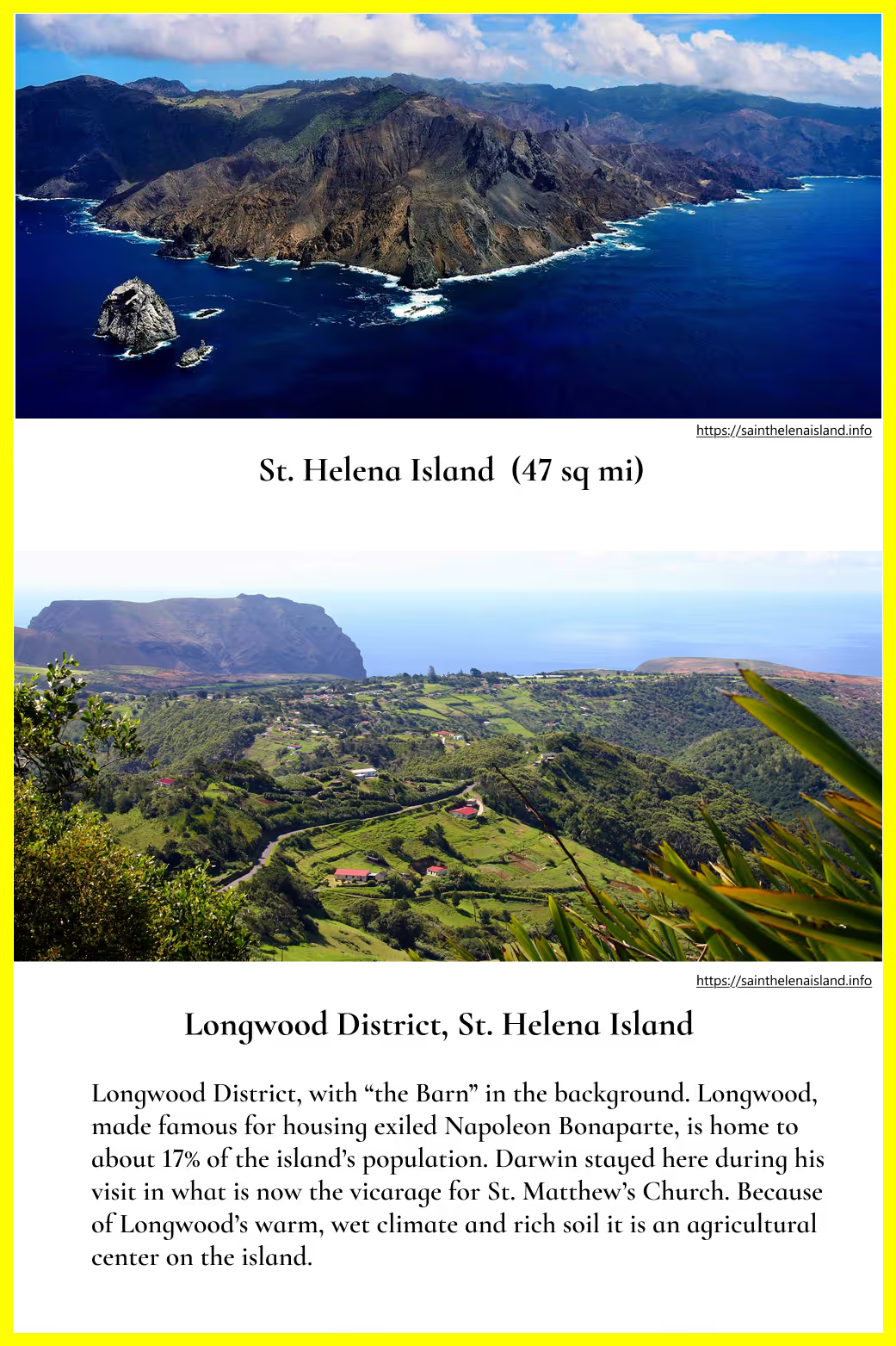
MAY 9th.— We sailed from Port Louis, and, calling at the Cape of Good Hope, on the 8th of July, we arrived off St. Helena. This island, the forbidding aspect of which has been so often described, rises abruptly like a huge black castle from the ocean. Near the town, as if to complete nature's defence, small forts and guns fill up every gap in the rugged rocks. The town runs up a flat and narrow valley; the houses look respectable, and are interspersed with a very few green trees. When approaching the anchorage there was one striking view: an irregular castle perched on the summit of a lofty hill, and surrounded by a few scattered fir-trees, boldly projected against the sky.
The next day I obtained lodgings within a stone's throw of Napoleon's tomb[1]; it was a capital central situation whence I could make excursions in every direction. During the four days I stayed here I wandered over the island from morning to night, and examined its geological history. My lodgings were situated at a height of about 2000 feet; here the weather was cold and boisterous with constant showers of rain, and every now and then the whole scene was veiled in thick clouds.
Near the coast the rough lava is quite bare: in the central and higher parts, feldspathic rocks by their decomposition have produced a clayey soil, which, where not covered by vegetation, is stained in broad bands of many bright colours. At this season, the land moistened by constant showers, produces a singularly bright green pasture, which lower and lower down, gradually fades away and at last disappears. In latitude 16°, and at the trifling elevation of 1500 feet, it is surprising to behold a vegetation possessing a character decidedly British. The hills are crowned with irregular plantations of Scotch firs; and the sloping banks are thickly scattered over with thickets of gorse, covered with its bright yellow flowers. Weeping-willows are common on the banks of the rivulets, and the hedges are made of the blackberry, producing its well-known fruit. When we consider that the number of plants now found on the island is 746, and that out of these fifty-two alone are indigenous species, the rest having been imported, and most of them from England, we see the reason of the British character of the vegetation. Many of these English plants appear to flourish better than in their native country; some also from the opposite quarter of Australia succeed remarkably well. The many imported species must have destroyed some of the native kinds; and it is only on the highest and steepest ridges that the indigenous Flora is now predominant.
The English, or rather Welsh character of the scenery, is kept up by the numerous cottages and small white houses; some buried at the bottom of the deepest valleys, and others mounted on the crests of the lofty hills. Some of the views are striking, for instance that from near Sir W. Doveton's house, where the bold peak called Lot is seen over a dark wood of firs, the whole being backed by the red water-worn mountains of the southern coast. On viewing the island from an eminence, the first circumstance which strikes one, is the number of the roads and forts: the labour bestowed on the public works, if one forgets its character as a prison, seems out of all proportion to its extent or value. There is so little level or useful land, that it seems surprising how so many people, about 5000, can subsist here. The lower orders, or the emancipated slaves, are I believe extremely poor: they complain of the want of work. From the reduction in the number of public servants owing to the island having been given up by the East Indian Company, and the consequent emigration of many of the richer people, the poverty probably will increase. The chief food of the working class is rice with a little salt meat; as neither of these articles are the products of the island, but must be purchased with money, the low wages tell heavily on the poor people. Now that the people are blessed with freedom, a right which I believe they value fully, it seems probable that their numbers will quickly increase: if so, what is to become of the little state of St. Helena?

MY guide was an elderly man, who had been a goatherd when a boy, and knew every step amongst the rocks. He was of a race many times crossed, and although with a dusky skin, he had not the disagreeable expression of a mulatto. He was a very civil, quiet old man, and such appears the character of the greater number of the lower classes. It was strange to my ears to hear a man, nearly white and respectably dressed, talking with indifference of the times when he was a slave. With my companion, who carried our dinners and a horn of water, which is quite necessary, as all the water in the lower valleys is saline, I every day took long walks.
Beneath the upper and central green circle, the wild valleys are quite desolate and untenanted. Here, to the geologist, there were scenes of high interest, showing successive changes and complicated disturbances. According to my views, St. Helena has existed as an island from a very remote epoch: some obscure proofs, however, of the elevation of the land are still extant. I believe that the central and highest peaks form parts of the rim of a great crater, the southern half of which has been entirely removed by the waves of the sea; there is, moreover, an external wall of black basaltic rocks, like the coast-mountains of Mauritius, which are older than the central volcanic streams. On the higher parts of the island, considerable numbers of a shell long thought to be a marine species occur embedded in the soil.
It proved to be a Cochlogena, or land-shell of a very peculiar form[2]; with it I found six other kinds and in another spot an eighth species. It is remarkable that none of them are now found living. Their extinction has probably been caused by the entire destruction of the woods and the consequent loss of food and shelter which occurred during the early part of the last century.
The history of the changes, which the elevated plains of Longwood and Deadwood have undergone, as given in General Beatson's account of the island, is extremely curious. Both plains, it is said in former times were covered with wood, and were therefore called the Great Wood. So late as the year 1716 there were many trees, but in 1724 the old trees had mostly fallen; and as goats and hogs had been suffered to range about, all the young trees had been killed. It appears also from the official records that the trees were unexpectedly, some years afterwards, succeeded by a wire grass which spread over the whole surface[3]. General Beatson adds that now this plain "is covered with fine sward, and has become the finest piece of pasture on the island." The extent of surface, probably covered by wood at a former period, is estimated at no less than two thousand acres; at the present day scarcely a single tree can be found there. It is also said that in 1709 there were quantities of dead trees in Sandy Bay; this place is now so utterly desert, that nothing but so well attested an account could have made me believe that they could ever have grown there. The fact that the goats and hogs destroyed all the young trees as they sprang up, and that in the course of time the old ones, which were safe from their attacks, perished from age, seems clearly made out.
Goats were introduced in the year 1502; eighty-six years afterwards, in the time of Cavendish, it is known that they were exceedingly numerous. More than a century afterwards, in 1731, when the evil was complete and irretrievable, an order was issued that all stray animals should be destroyed. It is very interesting thus to find that the arrival of animals at St. Helena in 1501 did not change the whole aspect of the island until a period of two hundred and twenty years had elapsed: for the goats were introduced in 1502, and in 1724 it is said "the old trees had mostly fallen." There can be little doubt that this great change in the vegetation affected not only the land-shells, causing eight species to become extinct, but likewise a multitude of insects.
St. Helena, situated so remote from any continent in the midst of a great ocean, and possessing a unique Flora, excites our curiosity. The eight land-shells, though now extinct, and one living Succinea, are peculiar species found nowhere else. Mr. Cuming, however, informs me that an English Helix is common here, its eggs no doubt having been imported in some of the many introduced plants. Mr. Cuming collected on the coast sixteen species of sea-shells, of which seven, as far as he knows, are confined to this island. Birds and insects[4], as might have been expected, are very few in number; indeed, I believe all the birds have been introduced within late years. Partridges and pheasants are tolerably abundant; the island is much too English not to be subject to strict game-laws. I was told of a more unjust sacrifice to such ordinances than I ever heard of even in England. The poor people formerly used to burn a plant which grows on the coast-rocks, and export the soda from its ashes; but a peremptory order came out prohibiting this practice, and giving as a reason that the partridges would have nowhere to build.
In my walks I passed more than once over the grassy plain bounded by deep valleys, on which Longwood stands. Viewed from a short distance, it appears like a respectable gentleman's country-seat. In front there are a few cultivated fields, and beyond them the smooth hill of coloured rocks called the Flagstaff, and the rugged square black mass of the Barn. On the whole the view was rather bleak and uninteresting. The only inconvenience I suffered during my walks was from the impetuous winds. One day I noticed a curious circumstance; standing on the edge of a plain, terminated by a great cliff of about a thousand feet in depth, I saw at the distance of a few yards right to windward, some tern, struggling against a very strong breeze, whilst, where I stood, the air was quite calm. Approaching close to the brink, where the current seemed to be deflected upwards from the face of the cliff, I stretched out my arm, and immediately felt the full force of the wind: an invisible barrier, two yards in width, separated perfectly calm air from a strong blast.
I so much enjoyed my rambles among the rocks and mountains of St. Helena, that I felt almost sorry on the morning of the 14th to descend to the town. Before noon I was on board, and the Beagle made sail.
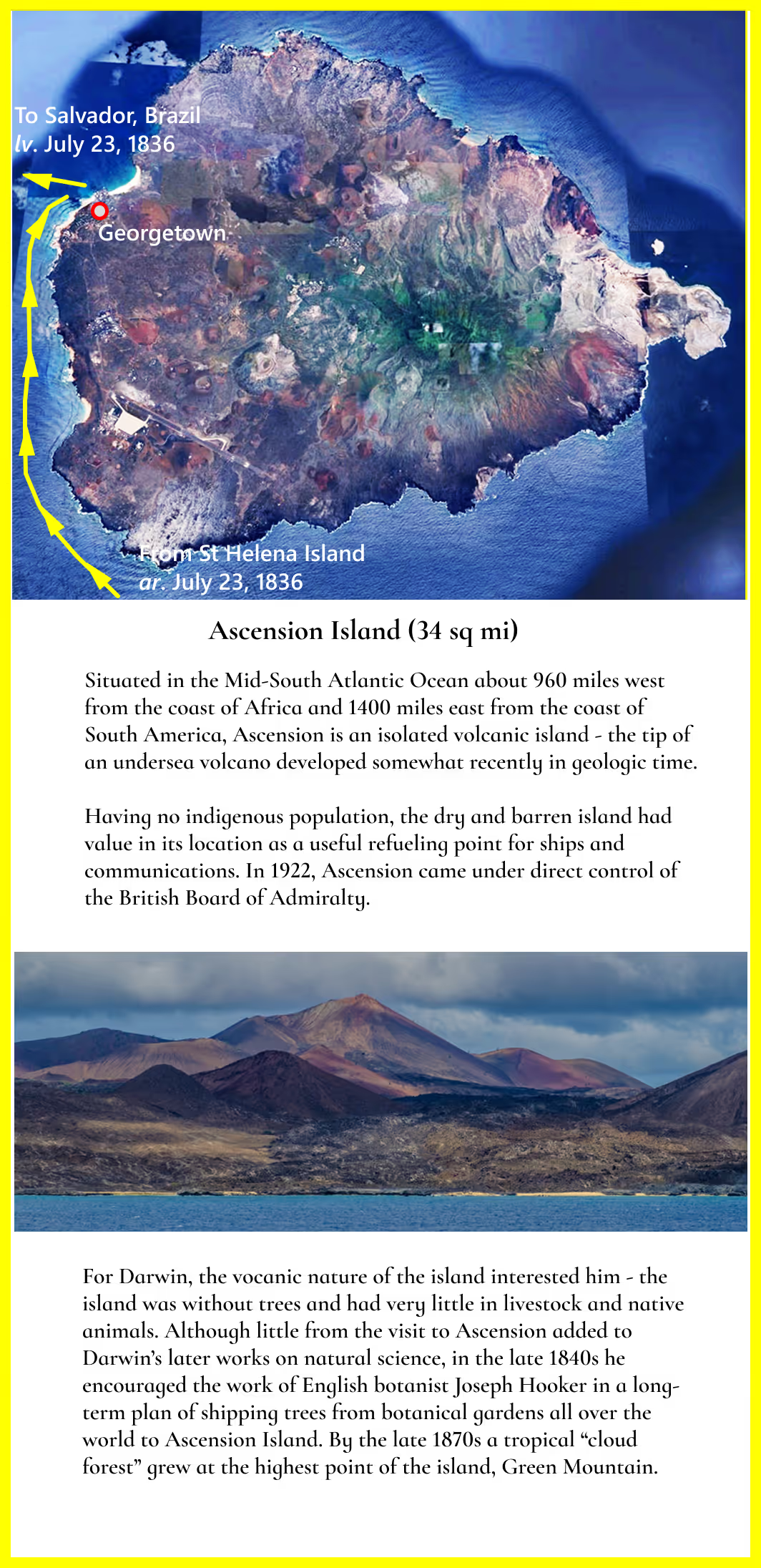
ON the 19th of July we reached Ascension. Those who have beheld a volcanic island, situated under an arid climate, will at once be able to picture to themselves the appearance of Ascension. They will imagine smooth conical hills of a bright red colour, with their summits generally truncated, rising separately out of a level surface of black rugged lava. A principal mound in the centre of the island, seems the father of the lesser cones. It is called Green Hill: its name being taken from the faintest tinge of that colour, which at this time of the year is barely perceptible from the anchorage. To complete the desolate scene, the black rocks on the coast are lashed by a wild and turbulent sea.
The settlement is near the beach; it consists of several houses and barracks placed irregularly, but well built of white freestone. The only inhabitants are marines, and some negroes liberated from slave-ships, who are paid and victualled by government. There is not a private person on the island. Many of the marines appeared well contented with their situation; they think it better to serve their one-and-twenty years on shore, let it be what it may, than in a ship; in this choice, if I were a marine, I should most heartily agree.
The next morning I ascended Green Hill, 2840 feet high, and thence walked across the island to the windward point. A good cart-road leads from the coast-settlement to the houses, gardens, and fields, placed near the summit of the central mountain. On the roadside there are milestones, and likewise cisterns, where each thirsty passer-by can drink some good water. Similar care is displayed in each part of the establishment, and especially in the management of the springs, so that a single drop of water may not be lost: indeed the whole island may be compared to a huge ship kept in first-rate order. I could not help, when admiring the active industry, which had created such effects out of such means, at the same time regretting that it had been wasted on so poor and trifling an end. M. Lesson has remarked with justice, that the English nation would have thought of making the island of Ascension a productive spot, any other people would have held it as a mere fortress in the ocean.
Near this coast nothing grows; further inland, an occasional green castor-oil plant, and a few grasshoppers, true friends of the desert, may be met with. Some grass is scattered over the surface of the central elevated region, and the whole much resembles the worse parts of the Welsh mountains. But scanty as the pasture appears, about six hundred sheep, many goats, a few cows and horses, all thrive well on it. Of native animals, land-crabs and rats swarm in numbers. Whether the rat is really indigenous, may well be doubted; there are two varieties as described by Mr. Waterhouse; one is of a black colour, with fine glossy fur, and lives on the grassy summit, the other is brown-coloured and less glossy, with longer hairs, and lives near the settlement on the coast. Both these varieties are one-third smaller than the common black rat (M. rattus); and they differ from it both in the colour and character of their fur, but in no other essential respect. I can hardly doubt that these rats (like the common mouse, which has also run wild) have been imported, and, as at the Galapagos, have varied from the effect of the new conditions to which they have been exposed: hence the variety on the summit of the island differs from that on the coast. Of native birds there are none; but the guinea-fowl, imported from the Cape de Verd Islands, is abundant, and the common fowl has likewise run wild. Some cats, which were originally turned out to destroy the rats and mice, have increased, so as to become a great plague. The island is entirely without trees, in which, and in every other respect, it is very far inferior to St. Helena.
One of my excursions took me towards the S. W. extremity of the island. The day was clear and hot, and I saw the island, not smiling with beauty, but staring with naked hideousness. The lava streams are covered with hummocks, and are rugged to a degree which, geologically speaking, is not of easy explanation. The intervening spaces are concealed with layers of pumice, ashes and volcanic tuff. Whilst passing this end of the island at sea, I could not imagine what the white patches were with which the whole plain was mottled; I now found that they were seafowl, sleeping in such full confidence, that even in midday a man could walk up and seize hold of them. These birds were the only living creatures I saw during the whole day. On the beach a great surf, although the breeze was light, came tumbling over the broken lava rocks.
The geology of this island is in many respects interesting. In several places I noticed volcanic bombs, that is, masses of lava which have been shot through the air whilst fluid, and have consequently assumed a spherical or pear-shape. Not only their external form, but, in several cases, their internal structure shows in a very curious manner that they have revolved in their aerial course. The internal structure of one of these bombs, when broken, is represented very accurately in the woodcut. The central part is coarsely cellular, the cells decreasing in size towards the exterior; where there is a shell-like case about the third of an inch in thickness, of compact stone, which again is overlaid by the outside crust of finely cellular lava. I think there can be little doubt, first that the external crust cooled rapidly in the state in which we now see it; secondly, that the still fluid lava within, was packed by the centrifugal force, generated by the revolving of the bomb, against the external cooled crust, and so produced the solid shell of stone; and lastly, that the centrifugal force, by relieving the pressure in the more central parts of the bomb, allowed the heated vapours to expand their cells, thus forming the coarse cellular mass of the centre.
A hill, formed of the older series of volcanic rocks, and which has been incorrectly considered as the crater of a volcano, is remarkable from its broad, slightly hollowed, and circular summit having been filled up with many successive layers of ashes and fine scoriae. These saucer-shaped layers crop out on the margin, forming perfect rings of many different colours, giving to the summit a most fantastic appearance; one of these rings is white and broad, and resembles a course round which horses have been exercised; hence the hill has been called the Devil's Riding School. I brought away specimens of one of the tufaceous layers of a pinkish colour and it is a most extraordinary fact, that Professor Ehrenberg [5] finds it almost wholly composed of matter which has been organized: he detects in it some siliceous-shielded fresh-water infusoria, and no less than twenty-five different kinds of the siliceous tissue of plants, chiefly of grasses. From the absence of all carbonaceous matter, Professor Ehrenberg believes that these organic bodies have passed through the volcanic fire, and have been erupted in the state in which we now see them. The appearance of the layers induced me to believe that they had been deposited under water, though from the extreme dryness of the climate I was forced to imagine, that torrents of rain had probably fallen during some great eruption, and that thus a temporary lake had been formed into which the ashes fell. But it may now be suspected that the lake was not a temporary one. Anyhow, we may feel sure, that at some former epoch the climate and productions of Ascension were very different from what they now are. Where on the face of the earth can we find a spot on which close investigation will not discover signs of that endless cycle of change to which this earth has been, is, and will be subjected?

End of Chapter XXI Part 2
[1] After the volumes of eloquence which have poured forth on this subject, it is dangerous even to mention the tomb. A modern traveller, in twelve lines, burdens the poor little island with the following titles,— it is a grave, tomb, pyramid, cemetery, sepulchre, catacomb, sarcophagus, minaret, and mausoleum!
[2] It deserves notice, that all the many specimens of this shell found by me in one spot, differ as a marked variety, from another set of specimens procured from a different spot.
[3] Beatson's St. Helena. Introductory chapter, p. 4.
[4] Among these few insects, I was surprised to find a small Aphodius (nov. spec.) and an Oryctes, both extremely numerous under dung. When the island was discovered it certainly possessed no quadruped, excepting perhaps a mouse: it becomes, therefore, a difficult point to ascertain, whether these stercovorous insects have since been imported by accident, or if aborigines, on what food they formerly subsisted. On the banks of the Plata, where, from the vast number of cattle and horses, the fine plains of turf are richly manured, it is vain to seek the many kinds of dung-feeding beetles, which occur so abundantly in Europe. I observed only an Oryctes (the insects of this genus in Europe generally feed on decayed vegetable matter) and two species of Phanaeus, common in such situations. On the opposite side of the Cordillera in Chiloe, another species of Phanaeus is exceedingly abundant, and it buries the dung of the cattle in large earthen balls beneath the ground. There is reason to believe that the genus Phanaeus, before the introduction of cattle, acted as scavengers to man. In Europe, beetles, which find support in the matter which has already contributed towards the life of other and larger animals, are so numerous that there must be considerably more than one hundred different species. Considering this, and observing what a quantity of food of this kind is lost on the plains of La Plata, I imagined I saw an instance where man had disturbed that chain, by which so many animals are linked together in their native country. In Van Diemen's Land, however, I found four species of Onthophagus, two of Aphodius, and one of a third genus, very abundantly under the dung of cows; yet these latter animals had been then introduced only thirty-three years. Previous to that time the kangaroo and some other small animals were the only quadrupeds; and their dung is of a very different quality from that of their successors introduced by man. In England the greater number of stercovorous beetles are confined in their appetites; that is, they do not depend indifferently on any quadruped for the means of subsistence. The change, therefore, in habits which must have taken place in Van Diemen's Land is highly remarkable. I am indebted to the Rev. F. W. Hope, who, I hope, will permit me to call him my master in Entomology, for giving me the names of the foregoing insects.
[5] Monats. der Konig. Akad. d. Wiss. zu Berlin. Vom April, 1845.
[6] I have described this Bar in detail, in the Lond. and Edin. Phil. Mag., vol. xix. (1841), p. 257.